
Washington County Parole or Probation
Parole and probation are not two names for the same status. Washington County Probation handles supervision ordered by the circuit court after a local case. IDOC's Parole Division handles people who have left an Illinois state prison but remain under community supervision. The Illinois Prisoner Review Board, or PRB, sets or reviews parole and mandatory supervised release conditions, conducts revocation proceedings, and may grant early final discharge.
Most people sentenced under modern Illinois determinate law leave prison on mandatory supervised release, often called MSR. Traditional discretionary parole mainly concerns older indeterminate sentences and certain youthful-review cases. A person released from Washington County Jail may have probation, state supervision, neither, or another case entirely. Release status cannot supply the answer by itself.
| Record type | Who orders it | Best verification |
|---|---|---|
| Washington County probation | Illinois circuit court | Sentencing or probation order and county docket |
| IDOC parole or MSR | State sentence and applicable PRB action | IDOC offender profile, then PRB records when relevant |
| Final discharge | Sentence completion or official PRB action | Official discharge status or order |
- Probation
- A court sentence served under community rules instead of, or following, local custody.
- Parole
- Conditional community release used for eligible discretionary cases.
- MSR
- Mandatory supervised release that follows many modern Illinois prison terms.
- Discharge
- The formal end of the sentence or supervision, not merely exit from prison.
Verify Washington County Supervision
Begin with the case that produced custody. Washington County does not publish a public probationer name search or an absconder list. The court docket establishes whether a local judge ordered probation. For a state-prison sentence, the IDOC offender search includes people currently incarcerated or on parole. Read the complete status rather than relying on a date alone.
- Confirm the person's full name, birth date when legitimately known, case number, and whether the sentence was local or IDOC.
- For local probation, open the Washington County Judici search and review the sentencing order and later docket entries.
- For a prison term, search IDOC by number when possible. Match identity, sentence county, Offender Status, and Location.
- Read Last Paroled Date and Projected Discharge Date together. A projected date is not proof that supervision ended.
- Use PRB decisions and the Paroled Registry for a traditional or youthful parole grant, later action, or revocation outcome.
- Ask the office that owns the record for direct confirmation when the public entries conflict or lack context.
An IDOC profile showing parole or MSR supports that prison confinement ended while state supervision continues. It does not show that the sentence is over. Conversely, a blank IDOC result proves nothing. A county-jail-only case may never enter IDOC, and a completed state sentence may be removed from the public search.
Washington County Probation Office
The local office serves court probation, not IDOC parole or MSR. Its official page names Jessica Eldridge as Chief Managing Officer, Jeff Goforth as Probation Officer, and Alec Valerius as Drug Court Officer. Because another circuit directory shows different staff extensions, the county's central number and published extension are the sound contact route.
Washington County Probation125 E. Elm Street
Nashville, IL 62263
618-327-4800 ext. 137
Fax: 618-327-9610
For state supervision help, the IDOC Parole Division offender-assistance line is 800-666-6744. The PRB is a separate body. Its operations office can address board proceedings at 217-782-7273 or prb.operations@illinois.gov, while routine supervision questions belong with IDOC.
The official Washington County Probation page is the source for local office details and forms.
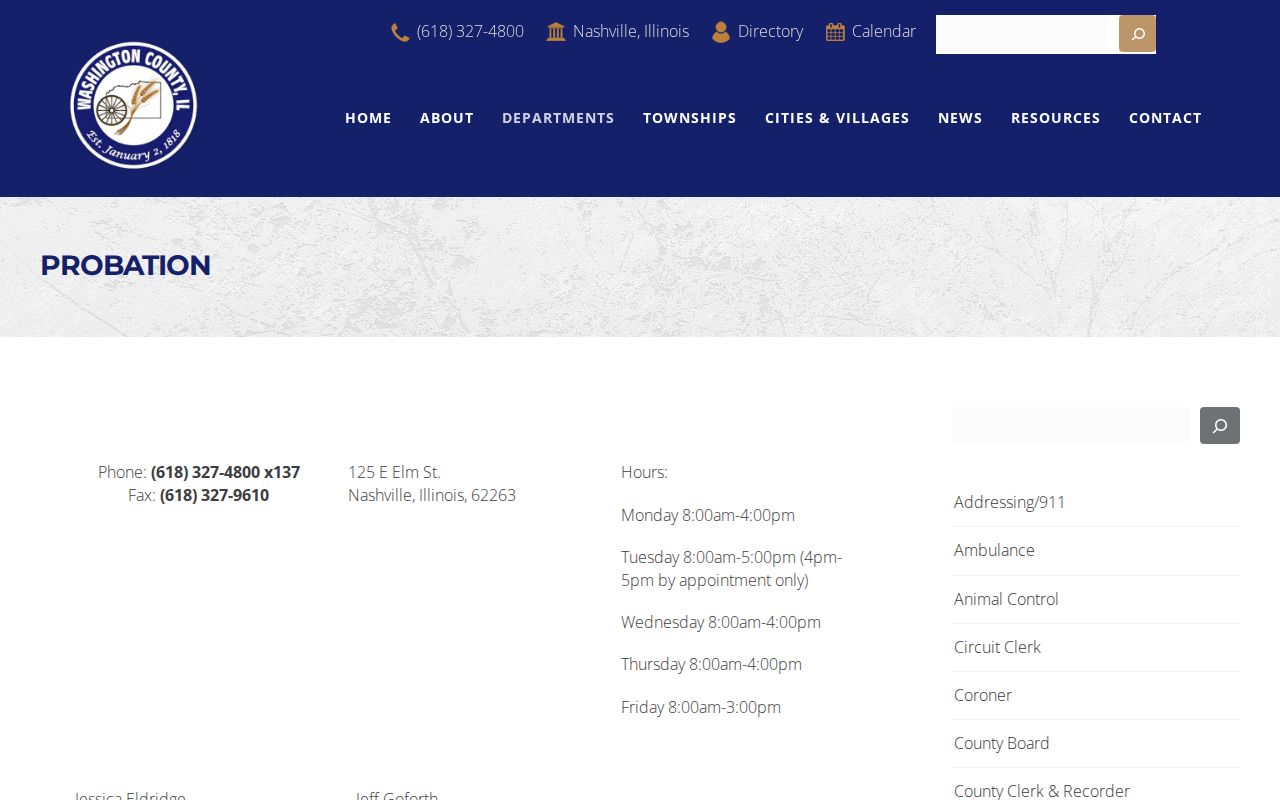
The captured office page distinguishes named local probation roles from the separate IDOC parole system.
Washington Supervision Violations
Conditions are rules attached to release or a probation sentence. They may include reporting, approved residence, treatment, travel limits, or other terms in the actual order. The controlling document matters. General descriptions cannot establish the conditions imposed in one person's case.
A missed meeting does not prove that a Washington County probation warrant exists. The county publishes no public absconder list. Look for a filed petition, warrant, or court order in the docket, then contact the proper office about process. State parole warrants and revocations belong to IDOC and PRB. County probation violations return to the circuit court.
PRB revocation results may show no violation, return to release with conditions, or revocation and return to IDOC. A scheduled hearing is only a future event. It is not an outcome and should never be treated as proof that release ended.
Washington County Supervision Discharge
Physical release and final discharge occur at different points. IDOC's Projected Discharge Date is forward-looking. PRB may consider early final discharge using compliance, the underlying case, risk and needs information, victim information, public safety, and an IDOC Parole Division recommendation. Only an official order or current discharge status confirms that supervision ended.
For probation, use the Washington County docket and termination order. For parole or MSR, compare IDOC status with the relevant PRB record. The Washington County released-inmate search paths explain how jail release, court authority, state custody, and final discharge fit together. Illinois FOIA may provide identifiable records subject to lawful exemptions, but it cannot turn a projected event into a completed one.
Washington Probation Office Hours
Washington County publishes a schedule with useful differences by day. The office is open Monday from 8 a.m. to 4 p.m. Tuesday runs from 8 a.m. to 5 p.m., but the final hour is by appointment only. Wednesday and Thursday are 8 a.m. to 4 p.m. Friday closes at 3 p.m. Those details matter when delivering a form or confirming a meeting.
| Day | Published hours |
|---|---|
| Monday | 8 a.m.–4 p.m. |
| Tuesday | 8 a.m.–5 p.m.; 4–5 by appointment |
| Wednesday–Thursday | 8 a.m.–4 p.m. |
| Friday | 8 a.m.–3 p.m. |
The same county page links reporting and meeting-verification forms. These local tools concern court probation. They do not report IDOC parole/MSR status.
Property After Washington Release
Post-release questions sometimes start with property rather than supervision. The official Washington County Jail inspection requires an itemized property inventory and return process. The released person signs a receipt, and the facility retains a permanent copy. Someone disputing what was returned can ask for that specific receipt and inventory record rather than rely on a broad request.
Medication and medical release documentation follow personal or authorized legal access rules. They are not treated like a general public property request. The Washington County Jail release page is the facility route; probation staff do not own the jail's property record.
Washington Parole Decision Records
The PRB calendar and outcome records perform separate jobs. The yearly En Banc schedule lists monthly dates for traditional indeterminate and youthful parole matters. It only establishes that a matter is scheduled. The En Banc hub supplies Current En Banc Results, a Paroled Registry, and open meeting minutes. Those sources may show a grant, denial, continuance, deferment, reconsideration, or another action.
After finding a result, compare it with IDOC's current offender profile. A grant may depend on an approved release plan and may change before physical release. A denial may set a later hearing. Neither an agenda nor a grant supplies the Washington County Jail release timestamp. Each record answers a different question.
Traditional parole eligibility largely applies to sentences under the law that preceded Illinois's modern determinate scheme. Certain qualifying people who were under 21 at the offense may receive youthful parole review. The rules include offense, sentence, date, and exclusion details, so a broad percentage rule is unsafe.
Washington Supervision Record Chain
A sound verification note names the source and the fact it proves. The Washington County court order can establish probation and its legal terms. The local probation office can explain reporting procedures. IDOC can establish current parole or MSR status. PRB records can explain a discretionary grant, revocation result, or early final-discharge action.
Illinois VINE can send custody-change notices, but it is not a probation lookup. A VINE event also cannot turn an unconfirmed absence into an absconder finding. If IDOC returns nothing, check spelling, prior names, birth date, and IDOC number, then ask whether the case ever entered state custody. Fully discharged records may require IDOC's archived Record Search.
- Use the circuit docket for probation and violation orders.
- Use IDOC for current state community supervision.
- Use PRB for board decisions and revocation outcomes.
- Use the jail record for physical release or transfer.
- Use an official discharge record before saying supervision ended.
This chain keeps prison exit, local release, probation, MSR, and final sentence discharge from becoming one unsupported claim.
When a copy must carry formal weight, request it from the Circuit Clerk, IDOC, PRB, or Sheriff's Office that created it. A portal summary may guide the search, while the originating record supplies the clearest date, authority, and status.
Source ownership also controls correction and follow-up. The Circuit Clerk owns the filed probation order and later violation docket. Washington County Probation administers local reporting but does not certify an IDOC parole status. IDOC owns its current offender profile and Parole Division supervision record. PRB owns its hearing, revocation, condition, and early final-discharge decisions. The Sheriff's Office owns the local jail release or transfer entry. If two sources appear inconsistent, compare their event dates and ask the office responsible for the disputed fact rather than asking one agency to interpret another agency's record.