
Washington County 24-Hour Feed Status
The Washington County Sheriff’s Office publishes agency contacts and records channels, but it does not provide a current inmate roster, a released tab, or a rolling 24-hour archive. No official 48-hour substitute was found either. A release list from a Washington County in another state is not a source for Nashville, Illinois. Its names, dates, and policies cannot establish what happened at Washington County Jail.
This absence changes the starting point. A request for a defined interval is the closest official substitute for a public same-day feed. Ask separately for community releases and transfers during an exact start and end time. That wording prevents a move to IDOC, another county, or U.S. Marshals custody from being grouped with people who walked out to the community.
The official sheriff page shown below is the local source for records contacts and confirms the absence of a linked release roster.
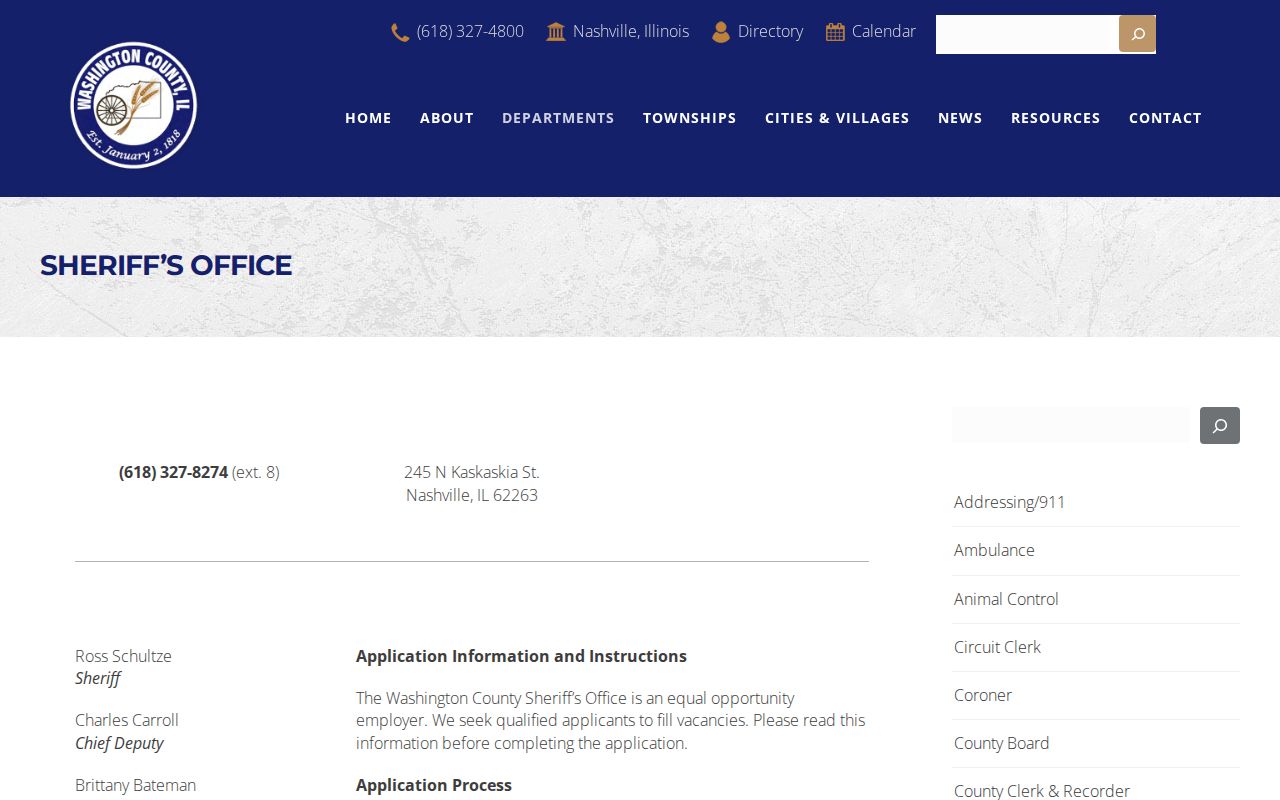
The screenshot supports the records fallback. It is not a capture of release results or a no-results screen.
Check Washington County Same-Day Releases
Begin with a narrow time range and the custody system that held the person. The sheriff owns the county jail release entry. The Circuit Clerk owns the court order. VINE relays events received from reporting agencies, while IDOC covers state imprisonment and parole. None of those records should be made to stand for another.
- Write the exact 24-hour start and end time, including the date, and collect a full name, date of birth if properly known, booking date, and case number.
- Contact the sheriff and ask for releases and transfers as separate categories. For one person, ask for the specific discharge or transfer entry.
- Review the Washington County Judici case search for bond, pretrial release, dismissal, sentence, probation, or commitment authority.
- Check Illinois VINE for a matching Washington County reporting record and save the event wording and timestamp. Confirm any unclear release or transfer notice with the reporting agency.
- If the entry names IDOC, another county, USMS, or another holder, continue with that agency. A local departure alone does not prove community release.
A named-person search follows a different path from an interval request. The full custody and records workflow is on the Washington County released-inmate search. The interval method above is designed to identify all agency-recorded movements in one day without pretending a web feed exists.
Washington County Release Record Fields
The 2024 IDOC inspection of Washington County Jail evaluates the facility against the rule requiring a record of release date, time, and authority. It does not publish a daily list or a fixed menu of release-reason codes. Request the actual field value and its code legend instead of suggesting that the reason was bond, time served, dismissal, or sentence completion.
| Requested field | What it can establish |
|---|---|
| Name and booking identifier | Matches the movement to the correct jail stay. |
| Admission date and time | Defines the custody period being checked. |
| Release or transfer date and time | Records when local custody processing ended. |
| Release authority | Names the order or agency authorizing the movement. |
| Verbatim type, reason, or destination | Helps separate community discharge from transfer. |
| Case and agency fields | Connects the entry to the arresting, holding, or receiving system. |
| Booking photo, if available | May help match identity, subject to lawful limits. |
The sheriff page does not publish a special request form, local fee schedule, or separate response promise. Illinois FOIA generally sets a five-business-day baseline for a noncommercial request, subject to a permitted extension and lawful exemptions. That period means a records response is retrospective, not an urgent live monitor.
Request Washington County Release Entries
Send a focused request to the Sheriff’s FOIA Officer at 245 N. Kaskaskia Street, Nashville, Illinois 62263, call 618-327-8274 ext. 8, or email foiarequests@washingtonco.illinois.gov. The agency also lists sdrecords@washingtonco.illinois.gov for records and invoices. Ask for electronic, segregable nonexempt portions and request a cost estimate before chargeable copying because no local fee schedule was verified.
A useful request states: “For the 24-hour period from [start] through [end], provide records of discharge, release, and transfer, separated by community discharge and agency transfer, including name, booking identifier, release or transfer date/time, authority, verbatim type or destination, case number, and releasing or receiving agency. Please include the code legend.” A one-person request should add the known booking or case identifier and approximate custody dates.
Do not ask broadly for medical, victim, juvenile, sealed, expunged, or unrelated private details. Illinois FOIA permits redaction or withholding for several law-enforcement, safety, privacy, and correctional-security interests. If part is withheld, ask for the cited legal basis and the remaining nonexempt fields.
How Washington Jail Processes Release
The official jail inspection gives Washington County a useful release checklist even though it gives no public daily schedule. Staff are expected to confirm identity, record the date, time, and authority, inspect and document injuries, conduct a search, inventory and return property, and document medication handling. A permanent signed itemized property receipt is also part of the process.
Those steps identify precise records to request after a same-day movement. They do not establish a routine release hour, exit door, weekend practice, family waiting place, ride rule, or gate payment. Call the sheriff before traveling. South Central Transit serves Washington County, but current route or demand-response availability must be confirmed with the transit provider and is not a jail-provided release service.
Medical and medication-release information is not an ordinary public list field. A released person or authorized representative should use the proper personal or legal access route. Property disputes are better tied to the signed receipt and inventory than to memory alone.
Why Washington Release Names Vanish
Washington County’s key data quirk is not a short online retention window. It is the lack of an official public roster or release archive. A person cannot be proven released by disappearing from a county screen that does not exist. The reliable pair is the sheriff’s timestamp-and-authority entry plus the order or receiving-agency record that explains the movement.
A court order may authorize pretrial release before staff complete physical discharge. Another warrant, detainer, county case, or federal hold can prevent a community exit. VINE may report an event quickly, but its data can lag the source and its wording may not rule out transfer. Save the notice, then confirm it.
For a broader interval, compare the process with Washington County 72-Hour Releases. Neither page represents a sheriff-hosted feed.
Note: A dated agency record is stronger evidence than a missing name, an undated report, or a court order that has not yet been executed.
Washington Releases Versus Transfers
Community discharge means local jail custody ended and no named agency immediately assumed custody. Transfer means the person left Washington County Jail but remained confined elsewhere. Washington County’s jail may hold people for area counties and the U.S. Marshals, so the arresting agency, physical jail, case jurisdiction, and releasing authority can differ.
| Record result | Next source |
|---|---|
| Community release | Sheriff timestamp plus the Washington County court order |
| Transfer to IDOC | IDOC offender search by number, name, or birthdate |
| Transfer to another county | The named receiving jail and controlling court |
| USMS movement | Federal docket, USMS custody records, then BOP if sentenced |
| Still in Washington custody | Sheriff confirmation and VINE monitoring |
An IDOC profile that shows parole or mandatory supervised release can confirm prison exit while supervision continues. A person whose IDOC sentence is fully complete may no longer appear in the web search and may require an archived IDOC Record Search. Federal and immigration systems have their own limits. Keep each statement as narrow as the source.
The court docket supplies legal context but not the jail’s exact exit time. A dismissal, bond order, sentence to time served, probation order, or commitment to IDOC can explain why local custody changed. Certified or complete copies come from the Washington County Circuit Clerk when the online summary is unclear. If a sentence commits the person to IDOC, classify the jail departure as a state transfer until IDOC later reports a prison exit.
Illinois VINE is useful for quick notice because it receives information from county booking systems, IDOC, other state systems, and circuit clerks. Search the matching record by name and available identifiers, then read both custody status and reporting agency. An “out of custody” event from one reporting body does not by itself exclude pickup by another. Save the event time and wording, and ask the named source to confirm the underlying event.
The narrow wording protects accuracy. State that Washington County Jail recorded a community discharge only when its record supports that result. State that local custody ended by transfer when another agency took control. If the response does not resolve the destination, say the destination was not established rather than describing the person as free.
Public Record Search
Sponsored Results