
Washington County 72-Hour Feed Status
The official Washington County Sheriff’s Office page contains contacts, staff information, and records channels. It does not link a roster, released tab, or rolling three-day archive. Research also found no verified 24-hour or 48-hour alternative and no official sheriff app that supplies recent-release records.
No online feed means there is no published cadence, list retention period, photo field, or filter to describe. The accurate substitute is an agency request with an exact 72-hour start and end time. Results should be labeled as records produced for that interval, not as a live release feed. Similar products operated by counties with the same name in other states have no bearing on Washington County, Illinois.
The official sheriff page shown below documents the local contact path rather than a released-person archive.
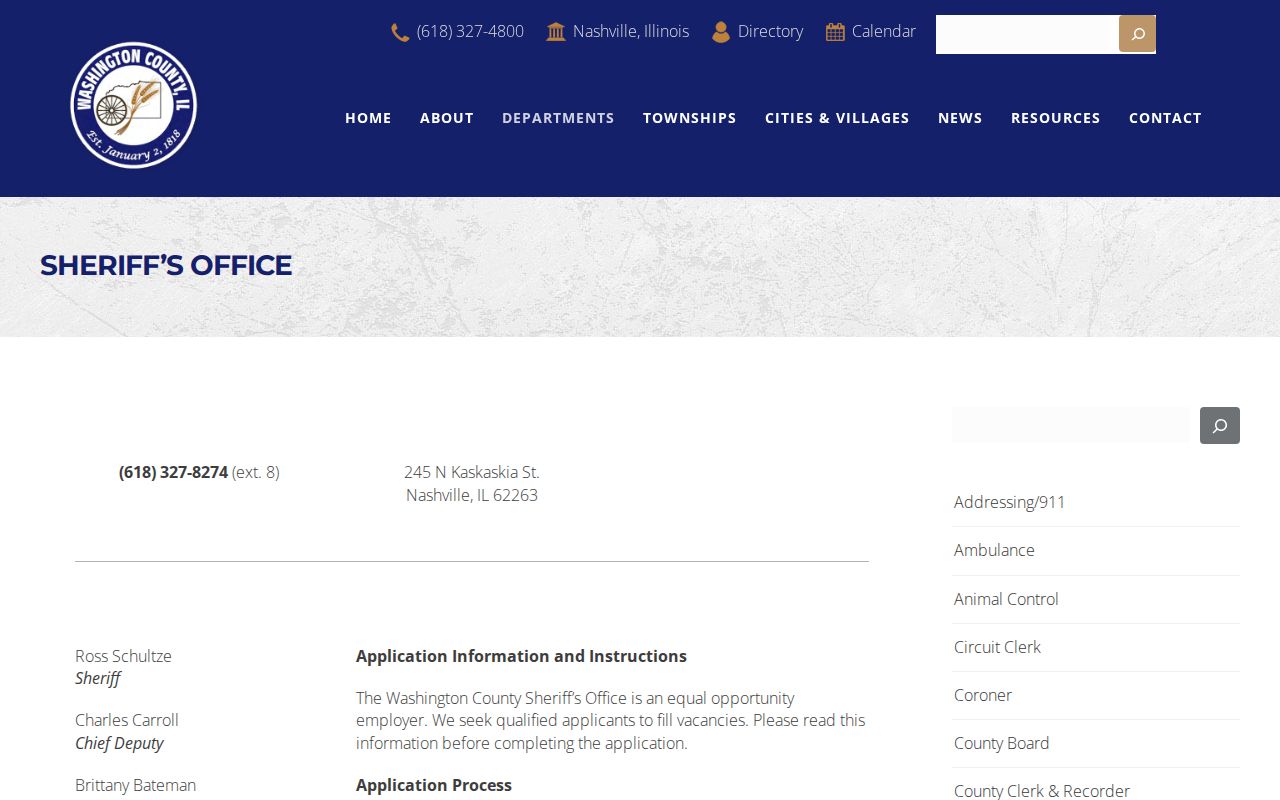
This image is evidence of the published access route. It does not represent live jail data.
Build a Washington Three-Day Window
A 72-hour inquiry works best as a reconciliation period. Set a beginning date and time, set an ending date and time, and keep the time zone consistent. Then ask the sheriff for both discharge and transfer events. A vague request for “recent inmates” may return too much, omit the movement field, or blur people who remained in custody elsewhere.
The wider window can help when an event, notice, and court entry fall on different dates. It is especially useful across a weekend or holiday period, when an order may appear before the physical discharge entry and an agency response may arrive later. No official Washington County source publishes a special weekend schedule, holiday rule, daily release hour, or guaranteed posting delay, so the page does not assign one.
- Fix the exact three-day range and gather known names, booking identifiers, case numbers, and arresting agencies.
- Ask the sheriff to separate community releases from transfers and include the date, time, authority, and destination fields.
- Match each local case in the Washington County Judici search, looking for the order that explains the movement.
- Compare any Illinois VINE event by reporting agency, event text, and timestamp. Contact the source agency when the event is unclear.
- Follow a named transfer into IDOC, another county, USMS, or another documented system rather than stopping at the Washington jail exit.
Washington County 72-Hour Record Fields
Washington County Jail’s 2024 facility inspection supports a local record of release date, time, and authority. It does not publish the jail’s internal codes or a public three-day display. The request should therefore seek the verbatim release or transfer value, along with the data dictionary or code legend, rather than assign a likely reason.
| Field | Use in a 72-hour review |
|---|---|
| Full name and booking ID | Prevents two jail stays or similar names from being merged. |
| Admission date and time | Connects the event to the right custody episode. |
| Release or transfer timestamp | Places the local movement inside the requested interval. |
| Authority | Identifies the court order, agency, or basis recorded by the jail. |
| Verbatim type and destination | Separates community discharge from continued custody. |
| Case and agency identifiers | Points to the court, arresting body, holder, or recipient. |
| Booking photograph, if available | Can aid a proper identity match, subject to lawful limits. |
These are fields to request, not claims about a hidden web list. The inspection also references injury documentation, property return, and medication handling. Sensitive health material is not an ordinary public release-list field and should be sought only through a proper personal or legal access channel.
What Illinois 72-Hour Law Means
Illinois arrest-information provisions include date and time received, discharged, or transferred among specified information and use 72-hour language for availability to news media after arrest. That legal deadline is not a rolling 72-hour released-inmate page. It does not establish a Washington County web feed, public search filter, three-day archive, or automatic photo gallery.
For a general public-record request, Illinois FOIA Section 3 generally provides a five-business-day response baseline for noncommercial requests, with an extension allowed for stated statutory reasons. That response period also differs from a live three-day list. A produced file looks back at the requested interval.
Lawful exemptions can protect juvenile, sealed, expunged, safety-sensitive, private, investigative, or correctional-security information. Ask for segregable nonexempt fields if part of a record is withheld. An agency’s redaction should not be filled with guesses.
Request Washington County Three-Day Records
The Sheriff’s FOIA Officer receives requests at 245 N. Kaskaskia Street, Nashville, Illinois 62263. The published phone is 618-327-8274 ext. 8, and the request email is foiarequests@washingtonco.illinois.gov. The sheriff also lists sdrecords@washingtonco.illinois.gov for records and invoices. No special sheriff request form, office hours, local fee schedule, or shorter response promise was verified.
A focused request can state: “For [beginning date/time] through [ending date/time], provide records showing each discharge, release, and transfer from Washington County Jail. Separate community discharge from transfer and include name, booking identifier, admission date/time, release or transfer date/time, authority, verbatim type or destination, case number, arresting/holding/releasing agency, and the code legend. Please provide electronic, segregable nonexempt portions.”
For one known person, narrow the request with the booking date, case number, and identifying details legitimately known. Ask whether another authority assumed custody. A targeted request is often more useful than a bulk interval when the real question is whether one person reached the community.
Note: Because no local fee schedule was found, request an estimate before chargeable duplication and ask for electronic records when they are available.
Why Washington Release Data Lags
Washington County’s distinctive roster issue is the absence of a public roster and archive, not a documented short retention period. There is no local screen whose disappearance can prove release. A phone report, VINE alert, or court entry may start the inquiry, but the sheriff’s timestamp-and-authority record remains the direct proof of local processing.
Sources can appear out of sequence. A judge may enter a release order before staff finish identity checks, property return, and other discharge work. A detainer or another warrant may keep the person in custody after the local order. VINE can lag the reporting system or use wording that does not distinguish transfer. A records response arrives after the interval has passed.
This is why a three-day review should preserve separate timestamps. Record when the order was entered, when VINE sent an event, when the jail logged release or transfer, and when a receiving agency accepted custody. Do not blend them into one unsupported time.
Trace Washington County Release Destinations
The Washington jail holds local detainees and can house people for area counties or the U.S. Marshals. A person’s arresting agency, physical holder, court jurisdiction, and releasing authority may all differ. The three-day result needs a destination check whenever the entry does not clearly state community discharge.
| Movement | How to continue |
|---|---|
| Community discharge | Pair the sheriff entry with the controlling county court order. |
| IDOC commitment | Use the official IDOC search and read status and location before date fields. |
| Other-county transfer | Contact the named receiving jail and controlling court. |
| USMS transfer | Check the federal docket and USMS; use BOP after federal sentencing and designation. |
| VINE custody event | Confirm the event with the reporting agency when transfer is not excluded. |
An IDOC result showing parole or mandatory supervised release means prison confinement may have ended while supervision continues. A fully discharged person can disappear from the IDOC public query and require an archived Record Search. “Not in BOP Custody” is limited to BOP and does not rule out state, local, immigration, or federal supervision.
Choose Washington Release Timeframes
Use the three-day interval to reconcile several days of agency movements, court activity, and notifications. Use the Washington County 24-Hour Releases process when the request is limited to one day and same-day logistics or property records matter. Both are records-request workflows because Washington County publishes neither feed.
For a named person, the broader Washington County released-inmate lookup follows county, state, and federal paths beyond the recent interval. That approach is better when the release date is uncertain or the person may have moved to another custody system.
Whichever period is chosen, describe only what the source proves. “Left Washington County Jail” can mean a transfer. “Court ordered release” may precede physical discharge. “No result” can reflect the wrong system, a spelling issue, a completed record moving offline, or restricted visibility. An affirmative agency entry is the sound basis for a release statement.
Keep the source date with every finding. Custody data can change after the three-day period closes, and a later agency record may clarify an earlier alert.
Public Record Search
Sponsored Results